Showing posts with label Amur River. Show all posts
Friday, January 13, 2012
Tuesday, November 15, 2011
Petropavlovskoe Lake, Nov 8, 2011
Petropavlovskoe is a big shallow lake 20 km east from Khabarovsk. I have decided to look for pike and other predators in the lake outlet below the village.
My wife had decided to come along. She had helped me to pump the kayak.
The lake outlet is 50 meters wide and 2-3 meters deep in the middle.
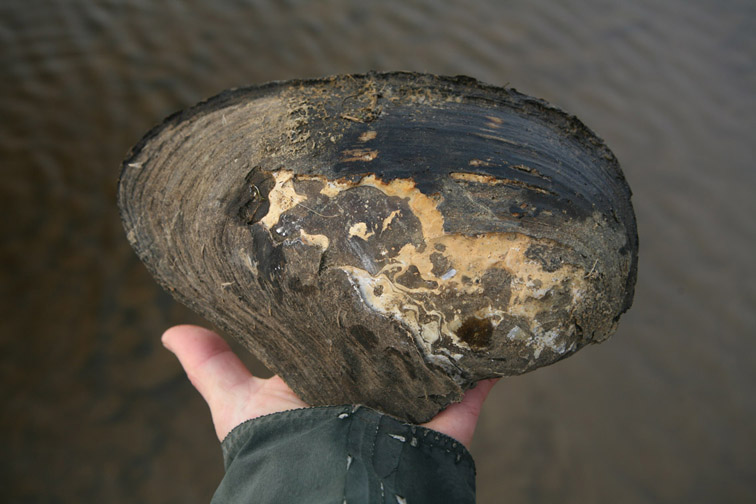
For several hours I was fishing in the current and in the bays, but with no success. I had only one sharp bite; the catch was heavy and pulling the line to the bottom.
This was a freshwater mussel. In the Amur River there are mussels up to 30 cm long. When the streamer touches its body, the animal closes the shells, and they clutch the hook. It is a true bite, even though the mussel is not trying to eat the fly..
Labels:
Amur River,
freshwater mussel,
Petropavlovskoe Lake
Sunday, November 13, 2011
Late fall at the Khoidur River
Khoidyr is a small forest creek which is flowing into lower part of the Amur River between Khabarovsk and Komsomolsk. It is crossing the road between these two cities 200 km from Khabarovsk. The fall of 2011 is unusually warm; at the time when it is normally snow and cold it is mild and warm. In the fall the fish from the creeks is leaving its summer habitats which will be frozen over soon, and goes down into the Amur River for wintering.
I have left the car at the bridge and was rowing upstream in a kayak. I will never burn gas and listen the rattle of a motor if I can avoid it.
This stretch of Khoidur is crossing the great plain - the valley of the Lower Amur. The banks are covered by the mixed forest and marshes - not as good a forest as we see in the mountains.
In deep slow pools I had some bites of Amur ide. This small fish is a predator. The imitation of an aquatic beetle with an action was a good selection on that day.
In such quiet forest creeks most of the fish (and all Salmonids) are found in the riffles.
Canadian beaver was stocked 40 years ago into the Nemta River 100 km to the west from here. The animals are now moving down the Amur River and populating its valley.
This nest belongs not to a bird, but to a bear. Don't you believe me? In August the Himalayan bear is climbing the Maak's bird cherry tree and eating its astringent berries. The animal is bending the branches, and pushes them under its seat at the tree to make the sitting more comfortable.
I was able to catch several little lenok and grayling
It is a pleasant catch - one of the last fish of the 2011 fly season
The winter is closing up - it has already come to the north of our region. In a month or less the fishermen will be catching lenok through the ice.
Sunday, November 6, 2011
Amur River, end of October 2011
Normally the fly-fishing season near Khabarovsk ends by November. In the end of October it is often below freezing in the morning; cold winds blow at the wide Amur River.
The water level in Amur this year is very low - about 1 meter below the conventional "zero level". Big sand spits exposed by the low water make the area look like the Sahara desert.
My friend Andrey and I were looking for Amur pike. This time of a year it is normally feeding along the shallow, sandy banks. The search requires lots of motor boat driving and hiking in the sand.
Andrey is casting a big streamer into a promisingly looking bay. That day the pikes were not cooperative at all.
On a way home we had decided to fish from a boat near one of the faster areas near the main waterway of the Amur. Such places have pebble bottom and attract different predators.
That day the fish were not active; they were holding near the bottom below the drop of a riffle. I had managed to get some bites only with a 50' fast sinking head, made of Rio T17 material. This is a skygazer.
Mongolian redfin was caught closer to the bank, where the current was not as strong. The fly which was so tasty at that day was an Antiwobbler with a foam back.
Both its upright blade and foam strip at the back help the fly to stay suspended when the heavy line moves on the bottom and pulls it down. During retrieve and in the current this fly is wiggling. Antiwobbler is the best fly to fish with a sinking line which you let sink to the bottom. In this case one is sure the fly is moving above the line, close to the bottom, but is not dragging in the mud. It is not catching snags as often as a regular streamer.
For more info on these new flies go here http://flyfishingrussia.blogspot.com/2010/12/new-fly-anti-wobbler.html
Labels:
Amur River,
Amur River flyfishing,
Mongolian redfin,
skygazer
Saturday, August 6, 2011
Ussuri River, first day of August 2011
Ussuri is a big right tributary of the Amur River; it is 897 km long. Along its middle & lower part Ussiri delimits Russia (right bank) and China. Two rivers meet in downtown Khabarovsk. Ussuri water is normally more clear than in the Amur.
About 5 in the morning I was at the Ussuri R in the southern part of Khabarovsk. The city downtown is 5 km downstream from me. It was still completely dark. Some fish were chasing fingerlings & splashing near the very bank. I had started to fish with a pearl Antiwobbler (see )with no foam and caught some small size skygazers (Erythroculter erythropterus). On a floating line this fly becomes a skater, and below the surface on retrieve it has a wobbling action and comes to the surface (http://flyfishingrussia.blogspot.com/2010/12/new-fly-anti-wobbler.html). Silver-and-pearl Antiwobblers is one of the best "flies" for the pelagic Amur River predators. Due to its active vibrations the fish can "feel" them even in murky water or in darkness.
The area where I was fishing is a gravel spit between a riffle and a bay with a back-current. The eddy forms a hole on the distance of 20-40 meters from me.
With the daylight the fish start feeding farther from the bank. I had shifted from a 9' rod to a double-handed one, with a floating head &15' sink tip. The fly was the same. The first bites were from Mongolian redfin. It is a beauty! The scientific name of the redfin is Erythroculter mongolicus.
Mongolian redfin (below) looks similar to the flathead asp (Pseudaspius leptocephalus) which dwells in the same river. The easiest way to distinguish the species is a long sharp spine in the dorsal fin of the redfin: asp has no such spine.
Amur three-lip (Opsariichthys uncirostris amurensis) is a small, avaricious predator. It is often biting flies & lures prepared for much bigger fish species.
About 8 AM I see mighty splashes - these should be the yellowcheek (Elopichthys bambusa). I am changing the sink tip to the clear, intermediate one. The fly is still the same.
This is a little yellowcheek - the biggest ones can reach 2 meters long! The fish is very strong; its bite feels like powerful pull, and the first run of even a small fish is dangerous for the tackle.
Powerful jaws of yellowcheek have no teeth - it is one of the Carps. To kill its prey the jaws have cutting edges and a know at the lower jaw - similar to European asp.
Powerful forked tail is much wider than the fish body.
This is the Antiwobbler which was working the best on that day
Wednesday, July 13, 2011
Manoma River, July 2011
Manoma River is a tributary to the mighty Anyui River, which is joining the Amur River from its right bank at the distance of 700 km from the sea. The upper reaches of the Manoma could be reached by old logging roads.
The river is 17*C, and the damp air - about 30*C. This creates fog which was rather thick during a part of that day.
In the morning I was barely able to see my friends fishing.
In the Manoma we normally catch lenok & grayling. The biting on that day was not too good; the fish was rather picky. We had luck with #10 Stimulator dry flies and with some dark nymphs.
The typical "lower Amur" grayling is normally small. The fish of this size is always mature. Compare it with Arctic grayling from the North - the minimum maturation size in many rivers is 28-30 cm.
In many places along the river the wide leaves of the butterbur are seen.
One of the flies which was working well on that day.
In June & July the brown bears are eating a lot of the butterbur chards. The severed chard continues growing, and forms a characteristic "flower" with 4, 5 or 6petals.
These are the "bear-flowers"
Labels:
Amur River,
brown bear.,
butterbur,
Manoma River
Saturday, October 2, 2010
Oct 02, 2010, Amur River in downtown Khabarovsk
Today I was fishing the Amur River in downtown Khabarovsk, near the "cliff" in the park. My main goal was testing new wobbler flies. These flies can be tied in different colors and sizes, but these were made for pelagic predators of the Amur River, first of all - skygazer.
The first fish I caught that day was tiny blackbelly. This was strange (even bigger specimens rarely bite flies).
About 10 AM I had a serious pull from the depth about 3 meters from the surface.
This was 72 cm long skygazer; it is also called Korean tarpon.
This fish belongs to carps, but looks like a giant herring.
The weight of fish was about 3,5 kg (close to 8 pounds)
Skygazer had bitten silver and pearl wobbler fly with yellow tail. There were more bites, but 2 landed fish were much smaller than the first one.
Sunday, May 23, 2010
Yesterday fishing - Petropavlovskoe Lake near Khabarovsk
On Saturday I was at the Petropavlovskoe Lake near Khabarovsk. Now the water level is +350 cm, and the flood-plain of the river is flooded. All fish including pikes is in side channels and in lakes, in flooded willows near the banks.
Small Amur pikes (generation of 2008) are now very numerous in the Amur River.
The best fly was red Mega-Diver with yellow tail.
Pikes were also biting big black flies; other colors (white, pink) did not work well.
Subscribe to:
Posts (Atom)