 The fish had probably a couple of chum salmon in its stomach. Taimen was released, so I can not tell it for sure. Chum salmon is numerous in Tugur; this is why there are so many big taimen in the stream - they have plenty of food. Some fish were observed moving behind a school of running salmon - exactly as a herder with a herd..
Thursday, December 17, 2009
One more trophy taimen
This trophy 40+ kg Siberian taimen was landed (gear, not fly, sorry) in October 2009 in the middle reaches of the Tugur River.
 The fish had probably a couple of chum salmon in its stomach. Taimen was released, so I can not tell it for sure. Chum salmon is numerous in Tugur; this is why there are so many big taimen in the stream - they have plenty of food. Some fish were observed moving behind a school of running salmon - exactly as a herder with a herd..

Wednesday, December 16, 2009
Manoma River, Amur River drainage. Part 1 - upper reaches of the river
Manoma River is tributary to the mighty Anyui R., which joins Amur River 200 km below Khabarovsk. Upper reaches of the Manoma are mountainous. This part of the stream is populated by selection of fish species which are typical for the "trout region" of the Far East: bluntnose lenok, sharpnose lenok, grayling, and Chekanovski's minnow.
In hot weahter of mid July it is a good idea to fish till the dark hours. In twilight you could expect bites from the most careful, older fish.
 Tributaries and side-channels of the Manoma River are small; here we catch mostly grayling

Tributaries and side-channels of the Manoma River are small; here we catch mostly grayling

Creek fishing is rather hard and requires lots of hiking and climbing. The casting is difficult - in many areas there is no room for backcast. The best tackle in this situation will be 7' or 8', 3 or 4 weight rod. Here I am using only furled leaders: common tapered ones does not allow to present the fly properly.
 Chekanovski's minnow is biting small flies, if you present them in bays and sloughs of a creek
 Lower-Amur grayling is easy to distinguish from other grayling species by its rounded dorsal fin with two red strips along the upper edge. This is very bright fish, which do not grow big - unlike the Arctic grayling.
 Cherry salmon in the Manoma River is rare fish - Manoma and Anyui are the uppermost spawning area of this salmon in the Amur drainage. This large smolt is, probably, a dwarf male which has "decided" to go out into the salt water after one or several spawnings with anadromous females. Typical cherry salmon smolts are much smaller.
 Lenok is sitting mostly near the bottom; it is not possible to catch this "Siberian trout" with dry flies every day. By the subterminal mouth one can see that this is the sharpnose species of the Brachymystax genus. This fish bit a heavy nymph, imitation "something edible" - probably, scud.
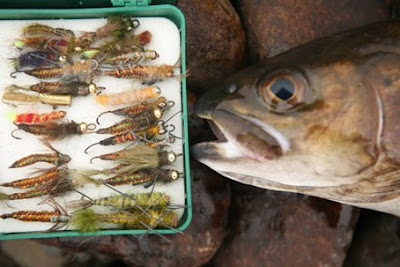
 This is the flybox of one of my friends. This fisherman can tie excellent superrealistic flies. Such fly models very popular in many regions of Siberia. The fish simply can not resist.

Chekanovski's minnow is biting small flies, if you present them in bays and sloughs of a creek
Lower-Amur grayling is easy to distinguish from other grayling species by its rounded dorsal fin with two red strips along the upper edge. This is very bright fish, which do not grow big - unlike the Arctic grayling.
Cherry salmon in the Manoma River is rare fish - Manoma and Anyui are the uppermost spawning area of this salmon in the Amur drainage. This large smolt is, probably, a dwarf male which has "decided" to go out into the salt water after one or several spawnings with anadromous females. Typical cherry salmon smolts are much smaller.
 Lenok is sitting mostly near the bottom; it is not possible to catch this "Siberian trout" with dry flies every day. By the subterminal mouth one can see that this is the sharpnose species of the Brachymystax genus. This fish bit a heavy nymph, imitation "something edible" - probably, scud.
 This is the flybox of one of my friends. This fisherman can tie excellent superrealistic flies. Such fly models very popular in many regions of Siberia. The fish simply can not resist.

Sunday, December 6, 2009
Sakhalin Island, Evai R. & Chaivo Bay, Part 2
After catching some more flounder from the bottom I had a different bite - a strong jerk of the line just after its landing. This was kundzha of whitespotted charr (Salvelinus leucomaenis). The ecological niche of the species is similat to the one of bull trout on the North-American coast of Pacific.
 This predatory charr can be as big as 15-18 kg, but it is reaching this huge size only in some waters. The biggest kundzha is found in some streams of the Eastern Kamchatka.
 On the shores of the Chaivo Bay grows larch forest. At the background you can see the narrow sand spit which separates the bay from the Sea of Okhotsk.
 Fresh starry flounder was put on a grill with onions
 Flowers of Labrador tea


Wednesday, December 2, 2009
Sakhalin Island, Evai R. & Chaivo Bay, Part 1
I had started to float the Evai River below the bridge - near the road from Nogliki to Okha. In its lower reaches the stream is deep & slow, it is meandering through the dark spruce forest. The fish population consists of salmon, sea-run taimen, charrs & Pacific redfin. In July the stream was almost enpty - all species of local fish are anadromous, and in summer they feed in the salt water.

Near Chaivo Bay there is no forest along the river, which is dividing into several channels
 Chaivo Bay is shallow; in low tide it is less than 1 meter in many places, and in some areas there is no water at all. In the background of the image you could see marine sand-spit; behind it is Sea of Okhotsk. Along the coast of north-eastern Sakhalin in July marine water was cold - about 5*C.
 I have started to fish on high tide from the anchored kayak; the depth was 120-150 cm. My main quarry should be bottom-dwellers, so I was fishing with full-sinking line and pink wooly bugger. During retrieve the fly was crawling right on the bottom. The first fish was marine sculpin.
 Starry flounder is very numerous in the Chaivo Bay. In Russia this fish always lays with its left side on the bottom; both eyes are at the right, dark side of fish.
 Both sides of starry flounder are covered by spiny, round bone plates. In the hands it feels like sandpaper. Comparatively to its size it is a strong fish.

To be continued...
Monday, November 30, 2009
Now it is winter in my home town
November in Khabarovsk is the first month of winter. Normally it is quite cold: about -20*C with wind. No flyfishing is possible. I like to tie flies and dream of warm summer, but I can not manage completely without fishing. So, when I can not flyfish I do icefishing. It goes for 5 months - only in April it will be possible to start to flyfish again - in the ice-holes on swift streams.

Amur whitefish is a predatory species. It is spending summers in cool tributaries of the Amur River, and migrates down into the main river in the late fall. This fish is among the species which are active unter the ice.

The freezing of the Amur River starts with moving slash-ice and fall ice-flood. After freezing the whole river is covered with ice-hummocks.
 In winter the wide and flat valley of the Amur River near Khabarovsk looks like desert. This desert is partly covered by ice, partly - by sand.
 This fish (Amur barbel or skin-carp) belongs to the Carp family (Cyprinidae). In Russian it is called "horse" due to the shape of its head. Skin-carp is among the species which are active under the ice.
 When it is really cold the best way to fish is to use a tent with fire-wood stove. This image shows winter fishing near Magadan at 60* North. In the Taui River we catch Arctic grayling and charr.
 In the first part of November near Khabarovsk there is normally no snow on the ground.
This time you could often see the fires - dry grass is burning.


Monday, October 5, 2009
Grayling & lenok, Khor River, Amur drainage, October 2009
Finally the water level in streams around Khabarovsk has come to normal. Now it is possible to visit one of the mountainous streams. We have decided to go to the Khor River - 200 km to the south-east of the city. The plan was to hire a local motor-boat which will take us upstream, and float back to the village for 2 days.

 This heavy blunt-nose lenok (Siberian trout) was caught from a moving boat. I was casting big "articulated" stone-fly imitation close to the rocky banks.
 These flies imitate huge stone-fly larvae, and are attractive for local Salmonids.
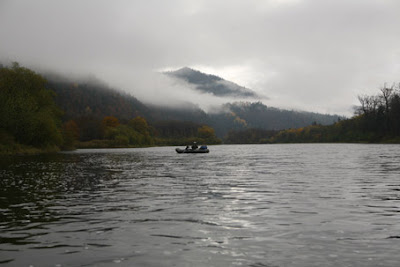
 Khor River is beautiful, but way too big for my taste...
 Even small grayling can bite the same huge fly. The belly of the fly is soft, so it does not feel unnatural for the fish.
 Floating in the last rays of the evening sun

We are moving upstream Khor River with local wooden "long boat". The river is swift and clear; its average width is 100-120 meters.

Amur grayling
 This heavy blunt-nose lenok (Siberian trout) was caught from a moving boat. I was casting big "articulated" stone-fly imitation close to the rocky banks.
 These flies imitate huge stone-fly larvae, and are attractive for local Salmonids.
 Khor River is beautiful, but way too big for my taste...
 Even small grayling can bite the same huge fly. The belly of the fly is soft, so it does not feel unnatural for the fish.
 Floating in the last rays of the evening sun

Monday, September 28, 2009
Nabil Bay, Sakhalin Island
Nabil Bay is one of the bays of the north-eastern Sakhalin Island. The bay receives water from numerous streams, and empties into the Sea of Okhotsk. Nabil Bay is very productive. Its fish fauna is mixture of marine, estuarine, and anadromous species.
 Our camp in the mouth of the Nabil River. It is high tide now.
 In many places the bay is shallow, its bottom is flat. Fish density in such areas is not as high as along deeper waterways formed by tidal currents.
 Marine sculpin caught with a fly
 Pacific redfin Tribolodon ezoe is anadromous Cyprinid
 We were fishing mostly from a boat
 White-spotted charr (kundzha in Russian) is the most numerous sport-fish of the bay. Kundzha is spawning in the fall in fresh water, in salmon streams. The fish are wintering in the river and migrate out into the bay for the whole summer for feeding. The fish is rather strong, especially when caught in the salt water.
 Most of the time I was using big and bright streamers
 Kundzha did prefer this fly to any other one
 "Anti-wobbler" fly with upright blade was also among the best lures for charr. On the retrieve this "fly" is wobbling and moves up; these movements resemble small baitfsh which is trying to escape.
 We were using mostly 2-handed rods. This tackle allows longer casts, which is necessary when fishing by wading.
 Very old wooden boat

Map of the Nabil Bay
 Our camp in the mouth of the Nabil River. It is high tide now.
 In many places the bay is shallow, its bottom is flat. Fish density in such areas is not as high as along deeper waterways formed by tidal currents.
 Marine sculpin caught with a fly
 Pacific redfin Tribolodon ezoe is anadromous Cyprinid
 We were fishing mostly from a boat
 White-spotted charr (kundzha in Russian) is the most numerous sport-fish of the bay. Kundzha is spawning in the fall in fresh water, in salmon streams. The fish are wintering in the river and migrate out into the bay for the whole summer for feeding. The fish is rather strong, especially when caught in the salt water.
 Most of the time I was using big and bright streamers
 Kundzha did prefer this fly to any other one
 "Anti-wobbler" fly with upright blade was also among the best lures for charr. On the retrieve this "fly" is wobbling and moves up; these movements resemble small baitfsh which is trying to escape.
 We were using mostly 2-handed rods. This tackle allows longer casts, which is necessary when fishing by wading.
 Very old wooden boat

Subscribe to:
Posts (Atom)


